Articles about satellite phones, equipment and satellite communications.
Inmarsat, Iridium, Thuraya, Globalstar
Opinion on Satellite Phones from Marc Weber
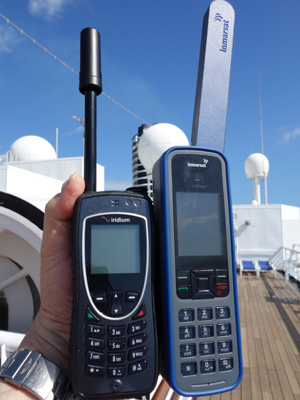
Marc Weber is a security specialist who discusses the necessity and usefulness of satellite phones in the modern world. Article translated from Forbes.com materials.
You can endlessly discuss the problems of global warming and the destructive consequences of these phenomena. But in any case, you need to be prepared for all these hurricanes, tornadoes, floods and fires that cause enormous damage to our infrastructure, including telecommunications.
During such incidents, cellular and landline towers always fail and the entire network is subjected to partial, and sometimes complete, destruction. Therefore, one of the most important technical items for such rescue operations is satellite communication and, in particular, satellite phones.
Satellite communication relies on a network of satellites that are either fixed above the equator (geostationary satellites) or located in low Earth orbit (about 500-1000 km above the ground). Satellite phones rarely suffer from natural disasters and, depending on the system architecture, can work anywhere on the planet. At the same time, modern satellite phones weigh about the same as familiar mobile phones.
Traditional buyers of satellite phones are government and public security agencies, energy companies, freight carriers, and search and rescue organizations. But every year more and more people buy these devices for their own needs, as insurance against losing contact with the world.
While you might never have thought of buying a satellite phone, learning a few key facts, especially considering the trend of declining equipment and airtime costs.
The first satellite network appeared back in 1965 under the name Intelsat, and this set a new direction for development in the field of world communications. This provided incredible opportunities, especially in the maritime world, where one company can now service communications for virtually every cruise ship in the world, and passengers and crew can make calls, use SMS and e-mail at sea.
In 1997, Motorola launched the first low-orbit satellite to provide communication anywhere in the world. The system was named Iridium and now consists of 66 satellites that have covered the entire globe with connectivity. The satellites are connected and transmit signals directly to each other, and when necessary to ground stations in thirteen different locations around the world. Ultimately, Iridium went bankrupt due to poor marketing and unrealistic demand expectations from users, but the network survived and now thrives.
Around the same time, Globalstar launched a similar network but with a completely different architecture called "bent-pipe." This system relied on 48 satellites positioned in orbit about 900 km above the Earth. Globalstar provides cellular-equivalent voice quality, unlike Iridium, which has extremely narrow bandwidth. This means that the voice transmission quality of Iridium (and Inmarsat as well) is somewhat worse than Globalstar.
Globalstar went bankrupt in 2002, losing about half of its first-generation satellites, and is now trying to restore its former power. Currently, Globalstar coverage is quite limited and not entirely reliable in 24/7 mode compared to other operators on the market.
The regional network Thuraya launched its first satellite in 1997 and began operations in 2001 in the UAE. The network was originally designed for quality coverage of Europe, Africa and the Middle East. Thuraya's communication equipment includes dual-mode handsets, meaning subscribers can use both GSM and satellite communication. Thuraya has already sold more than 600,000 satellite phones.
The fourth and final player in the satellite arena is Inmarsat. This company began its activities in 1979 with the maritime industry. In 2010, the IsatPhone PRO satellite phone was introduced, which, using the Inmarsat satellite network, covers the entire globe except the North and South Poles.
These four satellite networks basically offer the same service, but in different ways, with different coverage, types of technology and quality. Which system is right for you depends on where you plan to make and receive calls, and what other satellite communication services you may need.
How to Choose a Satellite Phone
You can find my interview with Eric Verheylewegen, CEO of GMPCS, one of the largest suppliers of satellite phones and equipment in the USA and Europe. We discussed in detail the various options for satellite phones and their limitations.
If you want to buy a satellite phone, expect to spend from $600 to $1700, depending on the network. All phones are lightweight, compact and can even replicate the functionality of your mobile phone. Some of them are equipped with Bluetooth and Wi-Fi modules, so you can use a wireless headset and connect to your computer wirelessly to transmit or receive data.
Satellite communication rates are often cheaper than typical roaming rates. This is especially important on board a cruise ship, where communication costs can be excessive.
Almost all satellite communication operators offer both contract rates and prepaid services. If you travel in Asia, Africa or South America, where the cost of a minute of conversation in roaming easily reaches $6 per minute — satellite communication will be a very attractive option for connecting with the outside world. It is also important to remember that terrestrial cellular networks offer coverage everywhere where there are population centers or major routes. Unlike this, satellite communication does not depend on this and does not need a communication tower.
- When choosing a satellite phone, the buyer often relies on the following factors:
- phone cost
- economics of use
- ease of operation
- global or regional coverage
- whether additional options are needed, such as GPS, coordinate transmission, tracking, SOS button, etc.
- Bluetooth and Wi-Fi capabilities
- Durability
- Ability to transmit data, e-mail and SMS
Satellite Phones vs Mobile Phones
All satellite phones have a number of common characteristics that you should know in order to choose the optimal device for you. Satellite and mobile phones have a number of architectural differences and limitations. A satellite phone will work almost anywhere on Earth, but at the same time, there may be interference or no connection at all in dense forest or indoors, and buildings in the city can also interfere. There are no such serious limitations with mobile phones, so in the near future satellite communication is unlikely to completely replace cellular, but satellite communication is a good insurance policy in case of failure or unavailability of the cellular network.
Here are some limitations you may encounter when using a satellite phone:
Antennas: unlike most modern devices, satellite phones have external antennas, and to make calls or send data, the antenna must be pulled out and pointed at the sky, otherwise there is no guarantee of quality and connection. This is due to the peculiarities of radio wave propagation and frequencies used by satellite communication. Thus, you will not be able to walk with a satellite phone in your back pocket and be sure that you will be reached.
International phone numbers: satellite phones, as a rule, use special international numbers, although some, for example Globalstar in the USA and Canada, use internal, assigned numbers. For some companies, it is important that the phone has a "local" phone number.
Calls to satellite phones can be very expensive from cellular or landline networks, depending on the tariff plan, the cost for the caller can reach up to 10 dollars per minute of conversation.
Global coverage: while some satellite operators provide global coverage, it is not absolute. In any case, there may be "dead zones". Interference can be caused by environmental factors, trees, dense foliage (jungles), tall buildings, mountains and other obstacles.
Voice quality: voice transmission quality may be lower than you are used to with cellular networks. This is because bandwidth is limited and optimization is used to reduce device power consumption. Also, there may be a delay in voice transmission, which is often encountered when using geostationary satellites, such as those of Inmarsat.
Phone design: all satellite phones are not particularly different in size and weight from ordinary phones, but at the same time they also have a number of limitations, such as: a large external antenna, display, soft buttons and other options, but at the same time, by sacrificing these, the phone becomes more protected from external influences (dust, water, impacts). Inmarsat probably offers the least expensive and easiest to use satellite phone, but it lacks some parameters that Iridium provides, including truly global coverage. All systems are sufficiently optimized, regardless of the phone and operator, they perfectly determine your exact geolocation using GPS.
E-mail and text: all modern satellite phones support working with e-mail through built-in clients and, of course, SMS. In this regard, the same services are offered as mobile phones.
What You Should Know About Different Satellite Networks
At the moment there are only two truly reliable and global satellite communication coverage providers: Iridium and Inmarsat. I have extensive experience working with Globalstar and I can say that, unfortunately, Globalstar cannot be attributed to global coverage, not to mention some network reliability problems. There are fundamental differences between the three operators, one of which you will most likely use (Iridium, Thuraya, Inmarsat).
Thuraya is a dual-mode operator (GSM + satellite communication), although it does not work everywhere, it is very attractive with its rates and phones.
Thuraya Rates.
Iridium
I have been using Iridium since its launch and have used it in many parts of the world. Iridium phones are compact, convenient and durable. I believe that Iridium 9555 is still their best device, despite the fact that the next model Iridium 9575 Extreme with extended capabilities has already been released. I used the 9575 last summer on board a ship in Europe and the Mediterranean and had some connection problems for the first time in fifteen years.
With Iridium, due to the peculiarities of the satellite constellation architecture, depending on your location and the satellite's location, communication problems may be observed. The advantage of Iridium is that it works in canyons, blocked mountain ranges, etc. because satellites are constantly flying overhead. This is also the only network that will work at the poles. Other Iridium characteristics that may affect your choice are: relative expensiveness of phones, phones can be tracked in location histories, panic alert feature. New models have the ability to send GPS coordinates. Phones can work with a hidden antenna, but coverage and signal will be reduced. The flagship Iridium 9575 has Wi-Fi and Bluetooth for data transfer and hands-free connection. Iridium Rates
Inmarsat
The Inmarsat network is time-tested and has been in operation for about 30 years. The Inmarsat geostationary satellite constellation is in orbit about 23,000 km from Earth and surrounds the equator. This means that when a connection is established — it is stable. Their phone IsatPhone 2 is probably the most affordable satellite phone while providing almost global coverage. Of course, the handset design is not as aesthetic as that of Iridium, but they are simple to use and my experience shows that connection stability far exceeds that of Iridium. With relatively equal voice quality between Iridium and Inmarsat, connection stability can become the deciding factor.
- Some important things you should know about Inmarsat:
- Durable and affordable phones
- Color display with excellent interface
- Affordable Inmarsat rates
- Fast IsatPhone 2 network registration (up to 45 seconds)
- For quality communication, there must be "open sky" and an unobstructed horizon
Globalstar
In my opinion, the Globalstar system is currently not reliable and is in the process of updating its second-generation satellites. At the same time, they offer very attractive airtime prices.
Phones, for example, GSP-1700, are not expensive and offer almost cellular voice transmission quality. But since calls are processed through satellite-ground station, the cost of calls to some destinations may be higher than expected. I think once they complete the update of their satellites — the quality and stability of communication will immediately improve, but at the moment I would not recommend using Globalstar satellite communication for search and rescue operations.
Satellite phones are now mainstream. They save lives by providing communication during natural disasters, and of course connect users with the outside world. Cellular networks are often fragile and can be unavailable for many reasons. Satellite networks rarely, if ever, fail, which means that if you decide to buy a satellite phone, you will almost certainly be in touch with emergency services, business, family and friends. This, in my opinion, is an inexpensive way to insure communication.
Look at it this way, in a situation where you lost your home, office and mobile phone, I'm sure at that moment you would give a lot just for a working phone.