Articles about satellite phones, equipment and satellite communications.
Inmarsat, Iridium, Thuraya, Globalstar
Satellite Internet and Communication for Sea and Sailors

When heading out on long voyages, sailors and sea travel enthusiasts need to stay connected with the outside world, news, and events.
Mobile Devices
Let's look at several options for satellite communication and satellite internet suitable for sailors. We have previously written about the portable satellite modem-terminal Iridium Go, which works well at sea, so now we will review similar mobile satellite internet devices.
We'll start with a simple and functional option — a competitor to the Iridium Go: the portable Wi-Fi router Thuraya Hot Spot. This is a portable router that works in conjunction with any Thuraya phone and provides access to satellite internet at speeds up to 60 kbit/s — which is quite sufficient for working with email and browsing web pages. Of course, downloading large files won't be possible, but the same applies to any devices of this type. We can only hope that in the future, technology will continue to advance and we will see portable satellite internet with speeds close to traditional broadband.
Currently, good speeds are only available with BGAN series terminals (access speeds up to 1 Mb/s), but they can only operate while stationary (sea swell and other movements will interfere with normal device operation).
Back to the topic: the Thuraya Hot Spot modem is used only in combination with a Thuraya phone — XT, Lite, or Dual. The device itself cannot operate independently. Multiple users can connect to the modem simultaneously. Also, when choosing a satellite modem, pay attention to the Thuraya network coverage area. The Hot Spot is a great device with an attractive price, excellent quality, and good tariffs, but it is useless if you do not have a Thuraya satellite phone.
Thuraya also offers an alternative — the Thuraya IP, which is heavier (1.3 kg), more powerful, and consequently more expensive. This is a full-featured satellite communication terminal that operates independently and serves as a good alternative to BGAN series terminals — with access speeds up to 450 kbit/s. If the regional coverage of Thuraya suits you, their tariffs will pleasantly surprise you.
Since Iridium and Thuraya have released their portable satellite terminals, Inmarsat did not want to lag behind and released the iSatHub iSavi. The terminal is called iSavi, while iSatHub is the name of the Inmarsat service, which is served by the Inmarsat-4 satellite. The device is quite easy to use, like its counterparts, and does not require any special technical knowledge. It features a traditional Wi-Fi module with a range of up to 30 meters, allowing any Wi-Fi-enabled devices to connect. The device allows making calls, sending SMS, and using data transmission. The access speed is quite good — up to 384 kbit/s, with the ability for multiple users to connect simultaneously. However, like other portable satellite communication terminals, signal quality and performance while moving are not guaranteed. The terminal is managed and configured via mobile applications (available for iOS and Android).
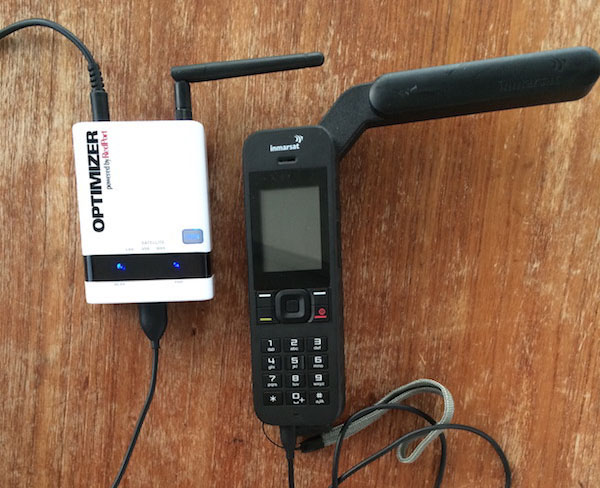
The Inmarsat IsatPhone 2 phone is in high demand among sailors. This phone is specifically designed for use in marine environments. One of its advantages is its relatively good data transmission speed (60 kbit/s) compared to its main competitor Iridium (2.5 kbit/s). This speed is generally sufficient for downloading weather files and working with email. However, if you purchase the RedPort Optimizer router for the phone (costing around $200–250; the router was developed specifically for satellite communication — it compresses and optimizes traffic), you will also get Wi-Fi access and the internet speed will increase 2–3 times. This combination makes it the best solution for mobile satellite internet at sea.
Iridium RedPort Aurora. This device offers 100% global satellite coverage. The Iridium Aurora easily provides your tablet, smartphone, or laptop with voice communication, data access, and GPS monitoring. Compared to competitors, the price is quite reasonable. Owners of sea vessels usually install a large amount of equipment — antennas, docking stations, separate satellite phones, various terminals, etc. All of this prevents the use of your own smartphone and ties you to specific devices. So if you are looking for devices to equip your yacht or vessel — take a closer look at the Iridium Aurora. Simple installation, affordability, satellite internet, satellite communication, and geomonitoring all in one device with global coverage.
Fixed Iridium and Inmarsat Terminals and Marine VSAT
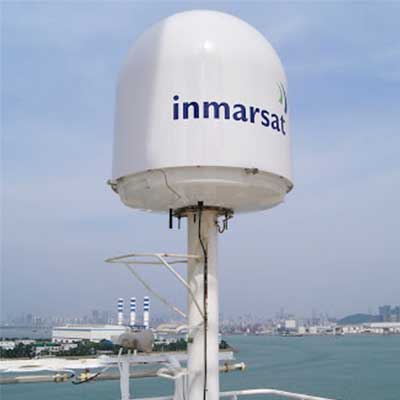
If the budget solutions described above are not sufficient for your needs, consider fixed satellite communication and internet devices — such as the Iridium Pilot or Inmarsat Sailor 150/250/500 models (the models differ in the set of additional functions, such as the number of ports and telephone lines). The main difference is the internet access speed. On fixed devices, access speeds range from 130 to 450 kbit/s. For most marine and other purposes, this is quite sufficient. Naturally, the cost of the equipment here is higher than for the mobile options described earlier, but the range of capabilities and internet access speed are incomparably better. These terminals work all over the planet, and tariffs do not depend on location. The only downside is the cost of traffic — there are no unlimited plans, and billing is per megabyte. This means you will need to carefully monitor traffic usage, disable unnecessary updates on devices, and use the internet only for essential purposes. This can be managed with a one-time firewall or similar system setup.
Another alternative is marine VSAT terminals (marine VSAT). A distinctive feature of the Sailor 600Ka and Sailor 900Ka VSAT terminals is that all tariff plans are unlimited. The subscription fee depends only on the required download/upload speed. The tariff grid is quite extensive, and you can choose the speed that best suits your tasks (access speeds from 51 kbit/s to 24 Mbit/s). The downside is that marine VSAT terminals cost several times more than the Pilot/150/250/500 models and have regional coverage (you can check it here). However, if you plan to use the internet connection constantly, the extra cost of the VSAT equipment will pay off quickly, since the cost per megabyte with Pilot/150/250/500 ranges from $1.5 to $27 per megabyte depending on the purchased traffic volume.
In summary:
> If you need voice communication and internet access only for email and weather files — the best options are the IsatPhone 2 or Iridium GO.
> If you need voice communication + full internet for specific tasks without heavy traffic consumption — consider the Iridium Pilot or Inmarsat Sailor 150/250/500.
> If you need constant high-speed internet at sea or to work with large amounts of data — consider marine VSAT.
If you have any questions regarding satellite communication or need help selecting equipment for specific tasks — contact us using any of the methods listed in the Contacts section. We will be happy to assist you.
Satellite Communication
Just 5–7 years ago, satellite communication was unaffordable for most people and was used only by a very limited number of enterprises. However, with technological progress, the price of satellite communication has decreased significantly, making it accessible to anyone who wants to buy a satellite phone or satellite modem for internet access and stay connected regardless of external conditions. While the cost of a minute of satellite calls used to sometimes reach $50, today prices are dozens of times lower — starting from $0.7 per minute, which is often cheaper than roaming, especially in remote areas far from civilization, not to mention at sea, in the mountains, forests, etc.
So, you have decided to buy a satellite phone. You are firmly convinced that you need a satellite phone for hunting, fishing, yachting, business, travel... You have more or less figured out the criteria and selected several options. Now all that remains is to choose a satellite communication provider. Since we currently only deal with Iridium, Inmarsat, Thuraya, and Globalstar, we will tell you about some nuances, advantages, and disadvantages of each.
Inmarsat Satellite Communication. Inmarsat is a time-tested satellite communication provider that has been on the market for over 25 years. It has upgraded its system several times and is now using the third generation. Coverage is global (excluding the polar regions) and is provided by 4 geostationary satellites. The Inmarsat system is used for monitoring sea vessels (it is the official system ensuring maritime safety) and aviation communications, so this is truly a reliable provider. The cost of calls is somewhat higher than that of competitors, but you have to pay for reliability and quality.
Iridium Satellite Communication. It uses low-orbit satellites and covers 100% of the Earth's surface, so you can be sure you will have coverage anywhere in the world. It produces very high-quality and rugged satellite phones (Iridium 9575 Extreme). Competitive call rates are also pleasing — starting from $1.1 per minute. The only downside worth mentioning is that the minimum voucher for 75 minutes costs $200 and is valid for only 30 days, which assumes fairly active use of satellite communication.
Thuraya Satellite Communication. It has a relatively small coverage area (bordered in the north of Russia and along the southern coasts of Africa). The service is stable and of high quality. Thuraya produces excellent devices, including the latest models — the Thuraya XT and Satsleeve. Thuraya offers quite affordable tariffs starting from $0.6 per minute, along with stable and high-quality service. Vouchers are valid for 2 years, allowing you to top up your account much less frequently. The only downside of Thuraya satellite communication is the limited coverage area, but we are confident this will be resolved in the near future.
Globalstar Satellite Communication. It is available in almost all countries, as it was originally designed to work in conjunction with regular cellular networks. Globalstar currently operates 48 low-orbit satellites. When you make a call via Globalstar, the signal is sent to several satellites at once, then transmitted to a ground gateway station, where the most suitable channel is selected and forwarded via terrestrial networks to the called party. This is the main distinguishing feature of Globalstar. It also offers fairly lightweight and portable phones, as they are not intended for extreme conditions. Call costs start from $1.4 per minute and are even cheaper when using the cellular channel. Finally, an important advantage is virtually no voice delay or echo, especially compared to providers using medium-orbit and geostationary satellites. Currently, Globalstar is experiencing connection issues in the European region due to the failure of several satellites damaged by solar radiation.
New devices for use at sea based on Iridium Certus have been announced. Read more.